
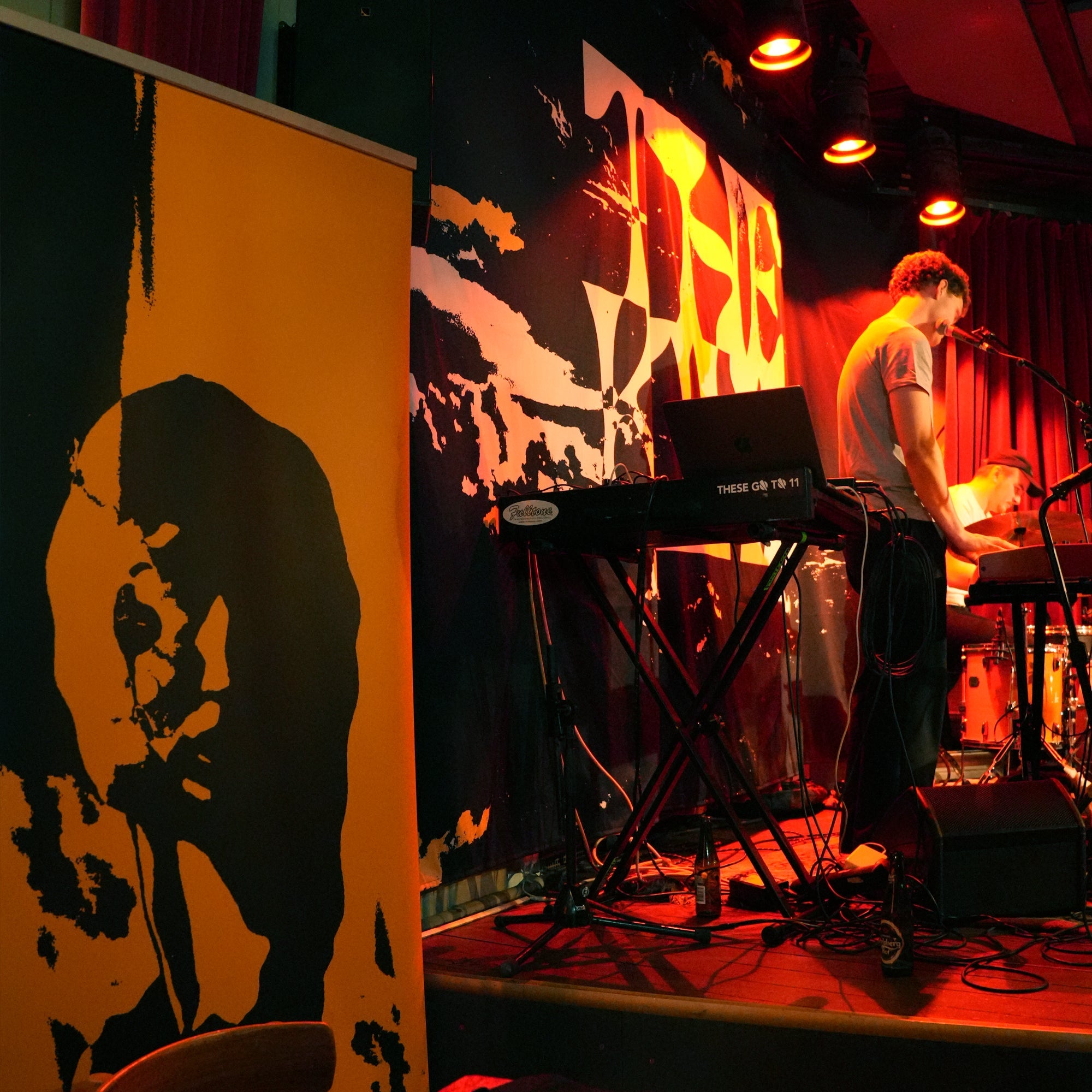
Whether you’re playing small clubs or large festival stages, the visual expression of the stage is a major part of the overall experience. The right stage visuals make a band look more professional, improve visibility in photos and video, and help you take control of the stage instead of disappearing into it.
Here we go through what is actually used on stage, how the different elements work, and how they can be combined in a smart way.
Backdrop – the foundation of the stage look
The backdrop is usually the most important visual element on stage.
It defines the band’s identity and appears almost everywhere: audience photos, live video, press images, and social media.
Typical use cases:
Clubs
Festivals
Tours
Showcases and competitions
A backdrop can be adapted in size to suit the stage, but the core idea is always the same: it creates focus behind the band and frames the entire performance.
Bass drum print – always visible, regardless of stage
The drum kit almost always ends up in the center of the stage. That’s why the bass drum is an extremely effective surface for a band logo or graphic expression.
A bass drum print:
Is applied as a decal on the existing drum head
Is available in all common inch sizes
Works equally well on small and large stages
Even when the rest of the stage is dark or visually busy, the bass drum remains clearly visible.
Sideups – flexible for clubs and smaller stages
Sideups are freestanding vertical banners placed on each side of the stage.
They are commonly used when:
The stage lacks truss
Setup time is short
You want something that works regardless of venue
Sideups are easy to transport and instantly add width and balance to the stage.
Sidedrops – textile banners for truss and side rigging
Sidedrops are made from the same fabric as the backdrop and are typically hung from truss systems or fixed rigging points.
They are especially suitable when:
The stage already has rigging options
A more cohesive visual expression is desired
You’re playing festivals or larger venues
Sidedrops make the stage feel more built and intentional rather than temporary.
Backdrop walls – for larger stages and productions
Backdrop walls are used to visually enclose the stage from the sides. This solution is best suited for larger stages where you want to create more weight and presence.
Commonly used at:
Large festivals
Tours with fixed stage production
Stages with significant width and depth
Here it’s not just about decoration, but about shaping the entire stage space.
Adapt or combine
The most important thing to understand is this:
👉 Bands rarely play the same type of stage every time.
That’s why it’s very common to:
Use sideups for club shows
Use sidedrops or backdrop walls on larger stages
Combine different solutions depending on the venue
The backdrop usually follows the band everywhere, while side elements are adapted to the conditions.
Summary
There is no rule saying you have to choose just one solution. Quite the opposite.
Many bands build multiple visual layers for their stage and use different elements depending on the venue.
A backdrop that always comes along.
Sideups for club shows.
Sidedrops or backdrop walls when the stage allows for more.
The result?
A band that looks consistently strong everywhere – and can always scale up instead of compromising.
Share:
Why Is a Backdrop Important on Stage?